This page records a massacre of Aboriginal people on Kabi Country — named dead, a public killing in the town and the river, and the sword given to the officer who led it.
01 · Listen
Come closer to the fire
That is the same fire our old people sat around long before the strangers came up the Mary. We do not tell it to make you hate. We tell it so you know what was done on our country — and so you never forget who we are.
Oral history · 3 minutes
The telling by the fire
Sit with it. An elder speaks the record of 3 February 1860 — the names, the river, the sword, and the people who are still here.
0:003:12
Read the transcript
0:00Soft paws, fire pops, coming close.
0:04My family, come closer to the fire, feel that warmth on your faces.
0:10That's the same fire our old people sat around long before the strangers came up the Mary.
0:18Tonight I'm gonna tell you something that happened right here on our country, not far from this river, Maryborough way, third of February eighteen sixty.
0:30They came riding in early that morning. Native Police. White officer named Bligh out front, troop of black trackers behind him. They had a piece of paper.
0:41A warrant said they only wanted one man. But that paper was just the excuse.
0:48They chased our people straight through the town, right past the stores, past the houses, past the white people standing there watching.
0:53Darkey — he worked in that town. Everybody knew him. They shot him down opposite Palmer's store, left his body lying there in the street, and then they roasted it.
1:10Young Snatchem, good man, hard worker. They drove him into the river near the public wharf.
1:19Scores of white people standing there — men, women, children — watching. Bligh got in a boat. Sat himself right up in the front.
1:27Forty, fifty shots they fired into that water. Five or six of them from Bligh's own carbine.
1:35When Young Snatchem was exhausted, floating, no fight left in him — Bligh lowered that gun and shot him in the back.
1:47Yankine was hit too. He lived. There was never a charge against him.
1:50And the old one-eyed man, grey-headed, blind in one eye — they put the handcuffs on him, marched him through the town like a trophy, took him out past the Six Mile, and he was never seen again.
2:08Two days later, four hundred white people filled that courthouse. They cheered. They clapped. They put five shillings each into a hat and bought Bligh a sword.
2:22A sword for shooting our people in the river and leaving a body to burn in the street. Then the government looked at it, called it justified, and promoted the man who did it.
2:36That's the truth, my family. Not the story they wrote in their papers. Not the story they told their children.
2:44This is the story that sits in the ground. This is the story that the river still remembers.
2:49We don't tell it to make you hate. We tell it so you know what was done on our country, and so you never forget who we are.
2:57We are still here. The fire is still burning. The law is still strong.
3:03Pass it on. That's enough for tonight. Sit with it. Feel it in your chest.
3:09We are Kabi. This is our ground.
02 · The record
A warrant for one man. A slaughter in the street.
Bligh rode in at dawn with a troop behind him. They had been tracking from the Six Mile Waterholes. They charged camps near Cleary’s and Melville’s, drove people through the town and into the river, and opened fire in front of the stores — in front of a crowd.
When
3 February 1860, early morning
Where
Maryborough township and the Mary River, Kabi Country
Who came
Native Mounted Police under Lt. John O’Connell Bligh
The excuse
A warrant said they wanted one man
Named killed
Darkey. Young Snatchem. The old one-eyed man disappeared.
Named wounded
Yankine — never charged, lived
03 · The names
Say their names
The official minimum is two killed and one wounded. The river, the street, and the old man’s disappearance tell a larger truth. Sheridan accounted for four that morning.
Shot in the street
Darkey
Worked in Maryborough. Everybody knew him. Shot down opposite Palmer's store. His body was left lying in the main street, and subsequently roasted.
Shot in the river
Young Snatchem
An excellent and industrious man. Driven into the Mary near the public wharf. When exhausted, unresisting, Bligh lowered his carbine and shot him in the back.
Wounded · lived
Yankine
Hit in the water. Recovered. Richard Sheridan told the 1861 Select Committee there was never a single charge against him.
Taken · never seen again
The old one-eyed man
Grey-headed, blind in one eye. Handcuffed, marched through town like a trophy, led out toward the Six Mile. The people brought word he had been shot. He was never seen again.
04 · The telling, in pictures
From the Six Mile to the courthouse
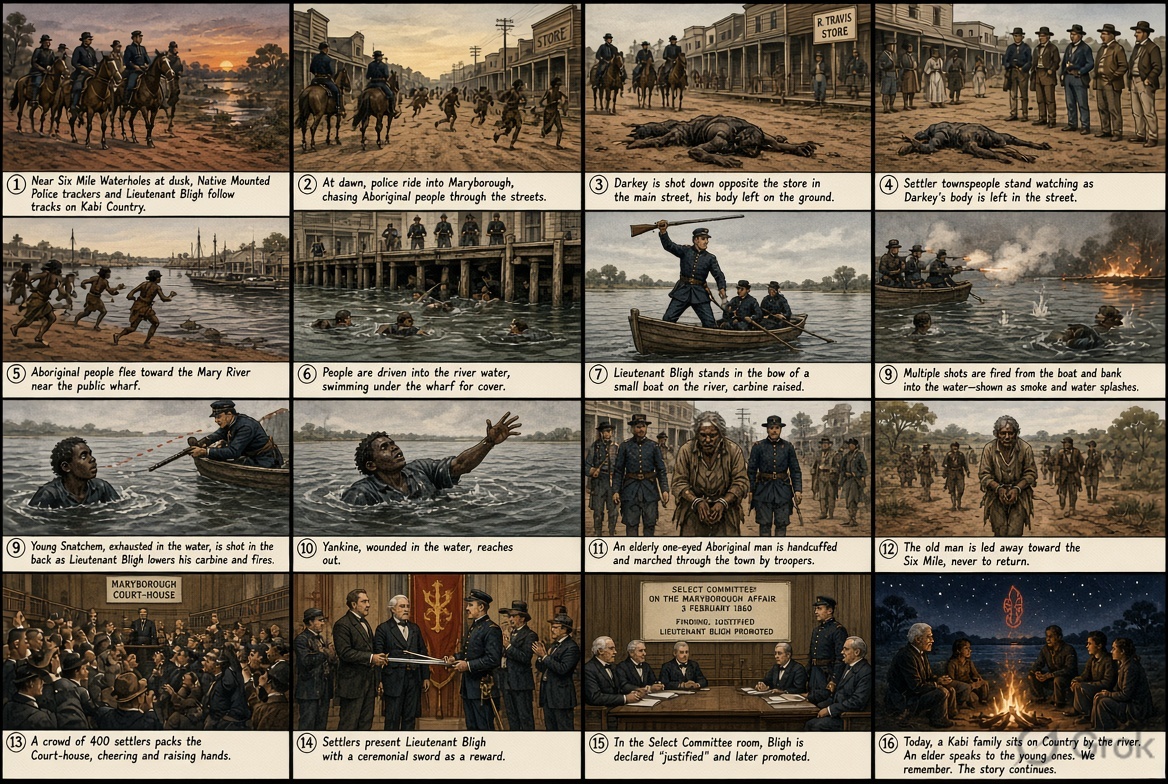
Sixteen frames. The ride in. The body in the street. The boat on the river. The sword. The committee that called it justified. And the family by the fire who still hold the story.
Walk the story
1 / 16
Near Six Mile Waterholes at dusk, Native Mounted Police trackers and Lieutenant Bligh follow tracks on Kabi Country.
05 · What happened
In the middle of the town, in front of everybody
Friday morning. Shouts of “stop him,” yells, the stamping of horses. Native Police chasing people through Maryborough. Some ran the streets. Some went through verandahs. Some hit the river and held on under the public wharf.
Richard Bingham Sheridan was at breakfast. He looked out and saw the pursuit. People told him a warrant was out against one man. Minutes later the shots started. A boat was on the water. Bligh was in the bow. Sheridan watched the officer fire four or five shots himself, and saw the man he fired at raise a hand and sink. That was the last that was ever seen of him.
Forty or fifty shots from the boat and the bank. Scores of settlers — men, women, children — standing on the wharf watching. Darkey, who could have been taken at any store in town, was shot opposite Palmer’s and left in the street. Young Snatchem was finished in the water when he had nothing left. Yankine was hit with no charge against him. An old grey-headed man, blind in one eye, was paraded in handcuffs and taken out of town.
“The gallant hero — the deserver of a sword — lowered his carbine, and shot the defenceless, tired, unresisting wretch, in the back.”
06 · The sword
Four hundred people bought him a sword
Two days later the Court-house was packed — about four hundred, the largest gathering Maryborough had seen. They thanked Lieutenant John O’Connell Bligh. They put money in a hat. They bought the emblem of bravery and put it in his hand.
An inquest on the man found dead in the town had been postponed. In the meantime the meeting went ahead. Depositions went to the Attorney-General. In 1861 a Select Committee of the new Queensland parliament heard Sheridan, then waited fifty-three days for Bligh, threw Sheridan’s account overboard, and declared the officer “perfectly justified in his attack on the blacks at Maryborough.”
The sword was not enough. They promoted him to Commandant.
07 · The archive
Read the full record
Compiled from the Frontier Conflict and Native Mounted Police in Queensland database, the Moreton Bay Courier, Sheridan’s 1861 testimony, and the committee that cleared Bligh. Download it. Keep it. Pass it on.
Attack on Aboriginal people — Darkey and Young Snatchem at Maryborough
3 February 1860 · PDF · 292 KB · 76 pages
Location notes, named dead and wounded, Bligh as named perpetrator, the settler meeting, the 1861 Select Committee extract, and the sources that survive in the colonial press.
Moreton Bay Courier, 21 February 1860 — the settler meeting that thanked Bligh
Moreton Bay Courier, 25 April 1861 — the letter on Bligh’s sword
Testimony of Richard Sheridan, Select Committee on the Native Police, 16 May 1861
Courier, 22 August 1861 — Native Police Report on the Maryborough slaughter
Freeman’s Journal, 29 February 1860
Bottoms, T. 2013. Conspiracy of Silence. Allen & Unwin. p. 52
08 · Still here
The fire is still burning. The law is still strong.
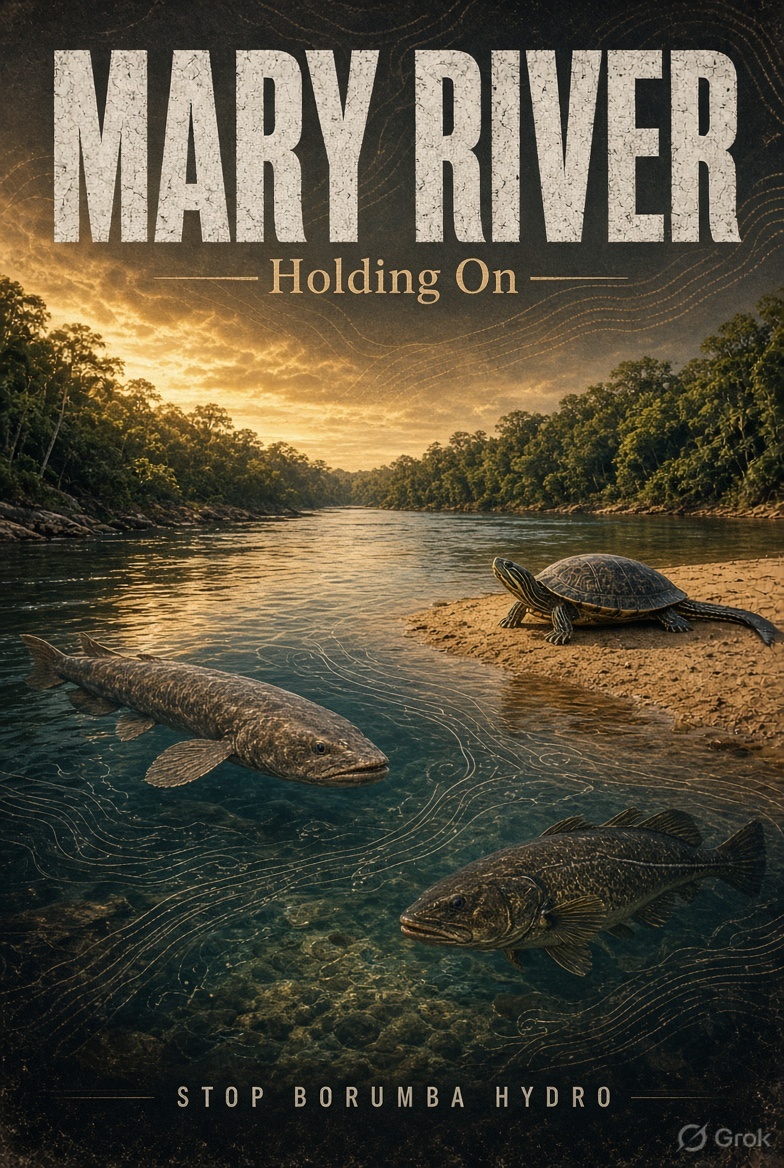
We are Kabi. This is our ground. The same river that took Young Snatchem is the river they want to break again. Holding on is not a slogan. It is the work.